
MSc in Technologies and Analytics in Precision Medicine
€9,000 (EU)/€25,000 (Non-EU)
As a biological data scientist, you'll work in the precision medicine field, which personalises treatments for patients using genetic profiling and improves diagnosis for different diseases.

Masters
1 year
In person - Full-time
90 ECTS
September 2027
RCSI campus open event for MSc in Technologies and Analytics in Precision Medicine
Do you want to become a biological data scientist and learn more about the new and exciting discipline of precision medicine? Join us at our Dublin city centre campus for an in-person open event on Saturday, 7 November 2026 from 12-1pm to learn more about this unique and innovative master's degree.
About
The health sector in Ireland is facing into a new era. Integrating areas such as data science, data analysis, omics, bioinformatics, computational biology, artificial intelligence and machine-learning to create a future of ‘connected healthcare’.
This award-winning Masters of Science (MSc) course has a core focus on precision medicine and data analytics and how to analyse healthcare data.
Study across five key areas including precision medicine, genetics, data analytics, connected health, and innovation. The primary emphasis will be on precision medicine combined with connected health and data analytics. You'll learn how to enable future growth in the healthcare and the (bio) pharmaceutical industry and gain the skills you need to begin or advance your career in this exciting new field.
This biological data analytics focused course, from the RCSI School of Pharmacy and Biomolecular Sciences, is delivered through:
- hybrid lecture models
- practical sessions
- workshops/tutorials
- round table discussions
The MSc also includes self-directed learning to create a better learning environment for our students and a research project module. Expert tutors teach this masters course as a full-time 12-month programme.
This course is a Level 9 award on the Irish National Framework of Qualifications.
Check out a recent article in The Irish Times about this exciting programme.
The MSc in Technologies and Analytics in Precision Medicine won the Pharma Education and Training award at the Pharma Industry Awards 2025. This win is an important acknowledgement of the industry relevance of this Masters programme.
MSc in Technologies and Analytics in Precision Medicine brochure PDF | 1257.5 KB


Develop advanced knowledge in the areas of genetics/genomics and precision medicine

Learn how to code and use programming language including R and Python to analyse big data generated from a healthcare setting

Understand how cutting edge connected health technologies and data are improving healthcare

Consider applications of artificial intelligence and machine learning in healthcare

Explore contemporary societal issues and assess innovative and leadership solutions

Apply theory to practice and undertake an original research project
Suitable for
This programme is designed for those who have an undergraduate healthcare degree (pharmacy or medicine) or a primary degree in biological, chemical or mathematical/statistical science, including computer science.
What you will learn
See section below
What our students say
Testimonial

"I was drawn to the opportunity to develop computational skills that could be applied to real biomedical research and healthcare challenges."
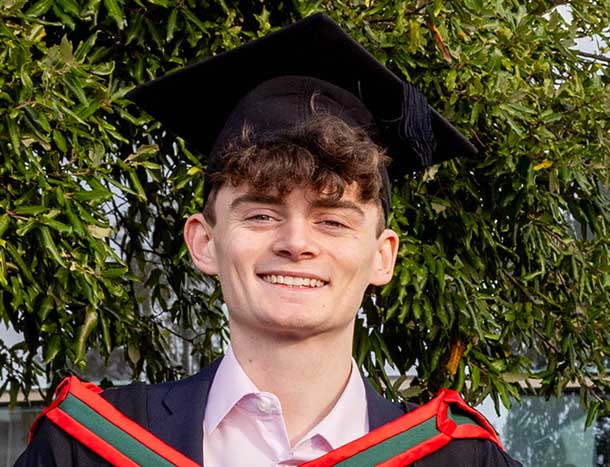
"My new role sees me assist in the design and development of digital health solutions ... both the job as well as the skills necessary can be attributed 100% to the programme. Without it, this career path would not have been possible ..."
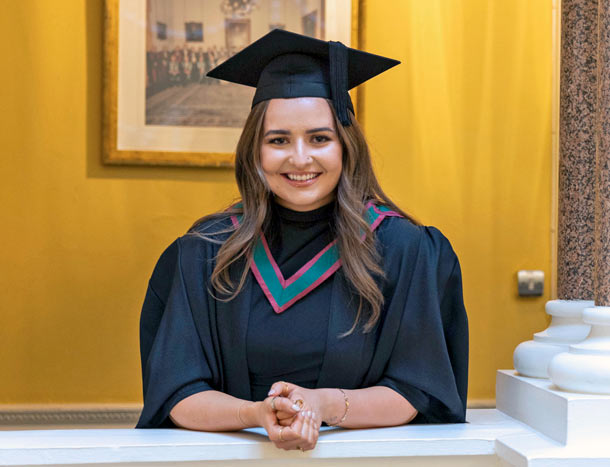
"In my new role as a clinical scientist, it’s so interesting to see how precision medicine can be applied, even at the diagnostic stage. The skills I gained helped me navigate through the competitive job market."

"Theory and practice are combined, ensuring graduates are ready to progress their careers. The great rapport between students and staff, as well as the compelling content, make it a really enjoyable experience."

"The way in which the course content is delivered is exceptional as we have a mix of classes, workshops with professionals in the various fields, case studies and computer labs."
Watch our introduction webinar
Find out more about this programme with an introduction from RCSI's expert faculty in bioinformatics, data analytics and precision medicine.
HCI Pillar 3 programme overview
Discover the human capital initiative (HCI), designed to bring higher education and enterprise closer together.
Register your interest
For more information about this course, please fill out the form below.
Course information
During this Precision Medicine MSc you will:
- Develop advanced knowledge in the areas of genetics/genomics and precision medicine.
- Develop core skills in innovation and leadership.
- Understand how cutting-edge connected health technologies and data are improving healthcare.
- Learn to program and analyse big data from healthcare settings.
Block 1: Genetics, Genomics and Precision Medicine
- Human Genetics and Genomics/Omics Technologies.
- Concepts of Precision Medicine.
- Applications of Precision Medicine.
Block 2: Data Analytics and Computational Biology
- Bioinformatics and Biostatistics.
- Computational Biology 1.
- Computational Biology 2.
- Advanced Statistical methods.
Block 3: Connected Healthcare
- Artificial Intelligence and Machine Learning in the Healthcare Setting.
- Connected Healthcare.
- Internet of Medical Things.
Block 4: Innovation and Leadership
- Innovation and Leadership.
- Contemporary Issues in Society.
Block 5: Research Project
- 12-week industry or academic research project.
A 12-week research project worth 30 ECTS with flexible research project choices. Project options to be provided by academic/clinical experts and enterprise partner, or the student can identify suitable academic or enterprise partner to develop a project proposal.
Proposal
Students will write up a grant proposal for the chosen project which will be evaluated (10% of total project grade).
Assessment
The research project will be assessed through a submitted research report (60%) and presentation (30% of total project grade).
The MScTAPM is a full time master's programme. Students will have in-class face-to-face lectures, workshops and tutorials as well as practical sessions facilitated by lecturers.
These sessions will be held on Wednesday, Thursday and Friday on a weekly basis from 9am-5pm. Monday and Tuesday are held for self-directed learning so you have time specifically reserved to complete assignments, build on your coding knowledge and prepare for exams and presentations.
Graduates of this programme will be equipped to become leaders in the health and bio-pharmaceutical industries of the future. As a biological data scientist, you will be in a position to apply for numerous roles across the bio-pharmaceutical industry, healthcare, clinical, and academic environments as well as healthcare sectors, including:
- Computational biologist
- Bioinformatician/bioinformatics scientist
- Life science consultant
- Health data analyst
- Connected health device developer
- Clinical project statistician
- Clinical trial protocol manager/designer
In addition, this course will further enhance students' academic profiles and make them highly competitive for PhD applications across national and international university/industry-based research programmes.
Hear from some of our recent MScTAPM graduates as they share their career journeys and discuss the exciting range of opportunities available following graduation:
We are proud to be a recognised University of the National University of Ireland (NUI).
Recognition by Ministries and bodies in other jurisdictions must be determined by the individual applicants.
Admissions
To be eligible for this Precision Medicine MSc, you should have successfully completed an undergraduate healthcare (pharmacy or medicine) degree or a primary degree programme (minimum of a 2.1 honours or equivalent) in a biological, chemical or mathematical/statistical science (including computer science).
In addition, if you hold a primary degree, with a second-class grade (H2.2) in a biological, chemical or mathematical/statistical science (including computer science) and with industrial experience you will be considered.
Suitable applicants will be invited to attend a short online interview prior to any offer of a place on the programme. This interview is to determine your suitability and motivation for undertaking the programme, and to provide you with an opportunity to ask questions about the course.
If you successfully secure a place on the programme you can apply for a student visa. RCSI can provide a visa letter to support an application for a student visa.
Please note
- You must liaise with immigration services independently to secure your own visa and ensure you undertake this in a timely manner, so your visa is secured for commencement of the programme.
If English is not your native language, an English language qualification is required. English language qualifications include a minimum overall score of 6.5 in the International English Language Testing System (IELTS), as per RCSI requirements.
More information about English language requirements for Postgraduate study at RCSI is available here.
EU fees: €9,000.
Non-EU fees: €25,000.
Please note:
- Fees are subject to annual review.
- Your annual fees include the €45 NUI fee.
- There is a non-refundable online application fee of €50.
- Fees can be paid by bank transfer, cheque (made payable to ‘RCSI’) or bank giro.
- The MSc in Technologies and Analytics in Precision Medicine programme is approved under the SUSI Postgraduate Course Grant Scheme. Students who qualify for the SUSI grant may apply for this fee support; however, the payment does not cover the total fee for the programme.
EU Payment Structure:
- First payment (deposit €1,000): within two weeks of offer letter being issued.
- Second payment (50%): Required by 1 June 2026, ahead of registration.
- Third payment (100%): Full payment due January 2027, as instructed by our fees team.
Non-EU Payment Structure:
- First payment (deposit €1,000): within two weeks of offer letter being issued.
- Second payment (50%): 12 weeks after deposit payment.
- Third payment (100%): Full payment due no later than 1 June 2026, ahead of registration.
- Official university transcripts: This must clearly show all subjects/grades received for each year of study and overall grade received. Documents must be provided in English or accompanied by an official certified translation.
- Transcript of results: required if undergraduate studies not complete.
- Up-to-date CV: Should include all relevant or healthcare-related employment that you have undertaken as well as your most recent employment details.
- English language qualification: A minimum overall score of 6.5 in the International English Language Testing System (IELTS), if English is not your first language.
- Photograph: this should be similar to a passport photo taken on a blank background and clearly show your head and shoulders.
- Survey/personal statement: completed during the application process, you will be asked about your motivations for applying, specific interests, and how you hope the masters will enhance your career after completion.
For instructions on the application process, please refer to this short video.
Once your application has been submitted it will be reviewed, and if shortlisted you will be invited to a short online interview.
Due to limited availability and the competitive nature of the selection process, not all applicants will be invited to interview.
As part of the application process, each eligible applicant is invited to a short online ‘interview’ on Zoom.
The purpose of the interview is to get a sense of your motivation in choosing the MSc and to understand how the opportunities, skills, and experiences gained from the programme aligns with your short and long-term career aspirations.
It also provides an opportunity for you to ask any questions you may have and to confirm if the programme is a good fit for you.
How to apply
Applications for the MSc in Technologies and Analytics in Precision Medicine programme are now open for September 2027.
Application deadlines:
Applications are assessed on a rolling basis and applications will close once they are filled. We advise you to apply as early as possible to avoid disappointment.
Please note, due to demand a wait list may apply.
Please review the 'Application checklist' and 'Interview' sections above, and begin your application below.