Introduction
Report by Abi Kelly, Director of International Engagement and External Relations
As we continue to deliver on the first pillar of our strategic plan, RCSI remains focused on our commitment to supporting health and societal well-being – locally, nationally and globally.
In 2024–25, we deepened our work with communities, strengthened pathways to higher education for underrepresented groups, expanded public engagement with science and health and took further steps to embed climate action into our operations and culture.
RCSI has long played an integral role in Dublin city centre, and our partnerships with schools and community groups in the south inner city have never been more important. Through initiatives such as the Creative Arts Summer School, Dublin Learning City and our partnerships with DEIS schools through REACH RCSI, our access and widening participation programme, we are raising educational aspirations for hundreds of young people. A core focus remains widening participation in STEMM subjects through targeted initiatives including TY MiniHealthSciences, the Primary Teachers’ CPD Science Programme and school-based science and health engagement.
In 2024–25, four RCSI students were awarded HEA-funded 1916 Bursaries and a further eight access students were awarded RCSI alumni-funded scholarships – Aim High (Medicine and GEM), Kiran Pathak (Pharmacy) and Takeda (ATT). These awards support students from priority groups underrepresented in higher education. In total, there were 31 RCSI alumni-funded access scholars and 21 HEA 1916 scholars registered in 2024–2025.
We also maintained a strong contribution to the national HEAR (Higher Education Access Route) and DARE (Disability Access Route to Education) schemes. In 2024, we reserved a minimum of 12% of school leaver places across all Undergraduate programmes – including Medicine, Physiotherapy, Pharmacy and Advanced Therapeutic Technologies – for students applying through these routes. This equates to at least 32 places annually. For a single-faculty, independent university with highly competitive entry requirements, this is a significant commitment and an important step in diversifying Ireland’s future healthcare workforce. Health equity remains at the heart of our REACH RCSI programme. This year, we expanded the ‘Health in the Community’ strand, using RCSI’s academic and clinical expertise to improve lifelong well-being locally. Public, patient and community engagement continues to be a key theme in our 2023–2027 Engagement Strategy. Physiotherapy students ran weekly exercise classes for older adults, while a partnership with Mercer’s Medical Centre supported a singing group to promote lung health. Patient groups also played an active role in research across areas such as Sjögren’s Disease, epilepsy and cancer. These collaborations enrich our academic and research activity while creating tangible health benefits for participants.
To support deeper public engagement with health, we are investing in a dedicated community-facing space within our new building at 118 St Stephen’s Green. Scheduled to open in 2026, it will be a free, interactive venue designed to foster dialogue around health and well-being through exhibitions, installations and discussions with RCSI experts.
RCSI remains a trusted source of accurate, accessible public health information at a time of increasing medical misinformation. RCSI MyHealth attracted strong engagement throughout the year, including a record in-person audience at an event on cannabis use and young minds. We also participated in the national ‘Soapbox Science’ and ‘Pint of Science’ events, bringing RCSI research into informal venues across the city.
In response to humanitarian crises, particularly the war in Gaza, RCSI is actively supporting global health in times of conflict. In 2024, we began collaborating with a medical NGO to expand emergency treatment capacity in the region, contributing to the care of up to 800 patients daily. We have also supplied medical education materials to displaced students, including our free open-access SURGHub surgical training platform, which won the Times Higher Education (THE) Award 2024 for Technological Innovation of the Year.
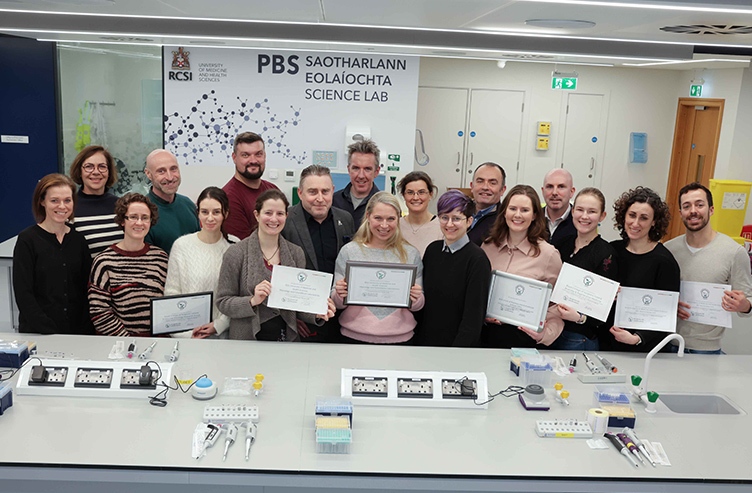
Finally, our commitment to planetary health continues to shape our institutional priorities. As the WHO has stated, climate change is the defining health challenge of our time. In 2024, RCSI achieved a 51.4% improvement in energy performance, meeting our 2030 public sector target six years ahead of schedule. The successful rollout of our Energy Performance Contract and a deep energy retrofit marked major progress. Further evidence of our work towards achieving the UN SDGs came through ISO 50001 certification, My Green Lab Accreditation for all of our laboratories and ranking first in the world for SDG3 ‘Good Health and Well-being’ in the THE Impact Rankings – the third year we have achieved this position.
These collective efforts reflect RCSI’s ambition to lead not only in healthcare education and research, but as an active partner in shaping a fairer, healthier and more sustainable society.