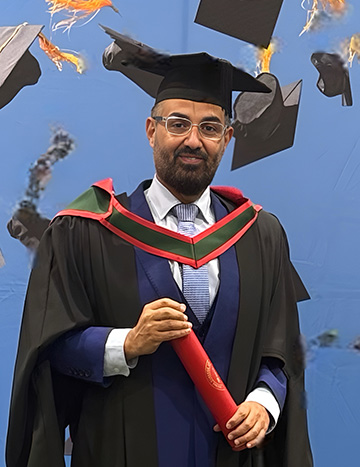
Raed Alkutshan
What's the best way to treat cardiovascular problems? Stop them happening in the first place.
I’m Dr Raed Alkutshan, an interventional cardiologist who has worked in many different countries, helping people with heart problems and diseases. When I came back to Saudi Arabia, I knew that I wanted to grow services in some of the smaller hospitals. But I knew that there was a gap in my knowledge of health management, so I enrolled in RCSI’s MSc in Healthcare Management.
My work is very busy, I have family commitments and I am often on call. I chose RCSI because of its strong reputation and the flexibility of its programme offerings. The programme was virtual, which allowed me to complete it on my own schedule.
At the start of the course, I faced a difficult personal situation which seriously impacted on my time, but the support and encouragement I received from the programme director and faculty gave me a profound sense of belonging and ownership, and ultimately contributed to my being named highest achiever on the MSc in Healthcare Management programme – an award given to the student with the highest overall mark.
These studies have been genuinely transformative. Though I entered the programme as a mid-career cardiologist and head of a cath lab – even previously head of department – these two years changed not only what I do, but how I think.
One assignment led directly to the introduction of a same-day discharge protocol in my cath lab, which is now fully embedded in practice. For my second-year project – the Triple-C (Cholesterol Control Catalyst), which focused on improving outcomes for cardiac patients by preventing cardiovascular disease in the first instance – I learned about working with multidisciplinary hospital teams and getting buy-in for a shared vision.
This project has now grown beyond the classroom: I have already discussed its national implementation with senior leadership in the Saudi Ministry of Health.
None of this would have been possible without the guidance, rigour, and vision instilled by the RCSI faculty.
To me, this is not simply a story of personal development – it is a testament to how RCSI empowers healthcare leaders to turn learning into real, measurable change for patients and systems.