Leading Impactful Research
Report by Professor Fergal O’Brien, Deputy Vice Chancellor for Research and Innovation
Our commitment to patient-focused research and collaborations with industry, charities, funding bodies, healthcare providers and other universities continues to enhance RCSI’s international reputation for research excellence, impact and sustainability.
Over the past year, we have seen continued success in innovation, journal publications, new grant funding, doctoral graduations and partnerships with external stakeholders. The Office of Research and Innovation (ORI) has provided dedicated support to researchers navigating an increasingly complex regulatory and funding landscape.
RCSI research in numbers
- 28,790 Altmetric mentions in 2024
- 169 Principal investigators
- 61% publications with international collaboration 2020-2024
- 32% publications in top quartile by CiteScore 2020-2024
- €7.9m industry funding for research in 2024
- €1.4m research commercialisation funding in 2024
Our efforts have enabled our researchers to conduct world-class translational, clinical and patient-centred studies. 2024 was another exceptional year for external funding with €44.8m in new grants awarded, including European Research Council (ERC) Starting and Proof of Concept grants, a Marie Skłodowska-Curie Actions (MSCA) COFUND, six MSCA Postdoctoral Fellowships, three Research Ireland Pathway awards, two Frontiers of the Future awards and two Health Research Board (HRB) Emerging Clinician Scientist awards. Through collaborative and interdisciplinary research projects, the university is advancing solutions to address pressing global health and environmental challenges.
With the support of the ORI and the Sponsorship Office, the Clinical Research Centre (CRC) implemented significant process improvements and strengthened its relationship with Beaumont Hospital to help drive clinical research activity. This has reduced study start-up timelines, led to the introduction of an electronic quality management system and almost tripled participant recruitment to studies in 2024 to 906 (from 325 in 2023). In the same year, 62 open studies were supported across 33 disease areas. The CRC team, led by Director Professor Ger Curley, has ambitious plans for the continued growth of clinical studies.
The Organisation of European Cancer Institutes (OECI) accredited Beaumont RCSI Cancer Centre continues to grow with the launch of the €4.9m Beaumont RCSI Irish Cancer Society Lung Outreach programme. Led by Professor Jarushka Naidoo (Department of Medicine), the programme aims to transform lung cancer research, bring state-of-the-art cancer care to the community and to enhance access to Irish Cancer Society support services. The €5m PRISM (Precision Oncology Research Initiative for Metastatic Breast Cancer) programme, led by Scientific Director of the Beaumont RCSI Cancer Centre Professor Leonie Young (Department of Surgery), was also launched this year to improve survival rates and quality of life for patients with metastatic breast cancer. I would also like to congratulate the Breast Cancer Biobank team, who became the first in Ireland to achieve ISO accreditation from the Irish National Accreditation Board (INAB).
RCSI plays a central role in two major national research initiatives under the €63.84 million Accelerating Research to Commercialisation (ARC) Hub programme, co-funded by the Government of Ireland and the European Union through the European Regional Development Fund (ERDF). The €34.3 million ARC Hub for HealthTech is a partnership between the University of Galway, Atlantic Technological University and RCSI, and is co-led at RCSI by Professor Garry Duffy, the newly appointed Head of the Department of Anatomy and Regenerative Medicine. It focuses on advancing translational research in chronic disease management through innovations including smart implants and wearables.
RCSI is also a key partner in the €31.6 million ARC Hub for Therapeutics, with Trinity College Dublin and University College Dublin with Professor Leonie Young leading this work. It aims to accelerate translational research in novel therapeutics, biomaterials, biomarkers and advanced therapy medicinal products. Both ARC Hubs will support further growth in innovation activity, where we have exceeded all Knowledge Transfer Ireland innovation targets for 2024, with particular credit to the RCSI Innovation Team for this success.
As part of RCSI’s commitment to the UN Sustainable Development Goals (SDGs), I am proud that RCSI became the first university in Ireland to have all of our laboratories attain My Green Lab Certification, setting a benchmark for sustainable research practices. I would like to thank all the lab managers, researchers and professional support staff involved, including John O’Brien (School of Pharmacy and Biomolecular Sciences), Dr Christopher Byrne (ORI) and Dr Niamh Connolly (Department of Physiology and Medical Physics.
118 St Stephen’s Green
In autumn 2025, 118 St Stephen’s Green will open, providing essential infrastructure for health sciences research, innovation and community engagement, including research laboratories for the Research Ireland FutureNeuro Centre and the Tissue Engineering Group (TERG). It will also be the new home for the RCSI School of Population Health.
The building will also house RCSI’s new innovative public engagement health space led by Dr Alison Boyle, Gallery Director. Located at the new building’s lobby on St Stephen’s Green, it will serve as a dynamic hub to foster dialogue on health and well-being, making medical knowledge accessible and engaging.
Research highlights
RCSI research output continues to be published in the top global scientific journals. Researchers at RCSI published a total of 1,652 PubMed-indexed articles in 2024, communicating research from a broad range of clinical, translational and population health science disciplines. Between 2020 to 2024, RCSI published 7,996 Scopus-indexed articles which generated 150,000 citations, 62% open access. Of this research, 61% was conducted through international collaboration with more than 4,500 institutions and 8% of articles were cited by over 1,700 policy documents and 300 policy bodies.
This high level of research output and citation impact has significantly contributed to RCSI ranking number one globally for UN SDG 3 Good Health and Well-being in the Times Higher Education Impact Rankings 2025. The dissemination and visibility of research output and impact is continually supported through strategic communications and we also invested in an update of the research information profile management system with features to help researchers build their online profile, find collaborators and enhance RCSI’s international reputation.
Some key publication highlights include:
Key role of T cells in blood clot risk for inflammatory bowel disease patients
A study led by Professor Roger Preston (School of Pharmacy and Biomolecular Sciences and the Irish Centre for Vascular Research), uncovered a novel mechanism linking inflammatory bowel disease (IBD) with an increased risk of venous thromboembolism. Published in Nature Communications, it identifies a specific subset of immune cells that may contribute to excessive blood clotting in IBD patients, revealing potential therapeutic targets.
Preventing epilepsy after traumatic brain injury
An international study led by Dr Tobias Engel (Department of Physiology and Medical Physics and FutureNeuro) found that targeting the P2X7 receptor could both reduce epilepsy risk and predict which patients are most at risk of developing post traumatic epilepsy. Published in the journal Theranostics, it offers a path towards prevention.
Discovering a new subgroup of common bleeding disorder
Research led by Professor James O’Donnell (School of Pharmacy and Biomolecular Sciences and the Irish Centre for Vascular Research) identified a previously unrecognised subgroup of von Willebrand disease, the most common inherited bleeding disorder. This newly identified subset of patients had normal quantities of von Willebrand factor but still exhibited symptoms due to mild functional defects in the protein. Published in Blood, the findings will enable more appropriate treatment and care.
Implant to power healing after spinal cord injury
Work by PhD student, Liam Leahy and a team led by Professor Fergal O’Brien (AMBER Centre, Department of Anatomy and Regenerative Medicine and the Tissue Engineering Research Group) developed an electroconductive 3D-printed scaffold that may encourage nerve cell repair after spinal cord injury. The researchers partnered with the Irish Rugby Football Union Charitable Trust on the project and brought together a public and patient involvement (PPI) spinal cord injury advisory group to oversee and guide the research. The study was published in Materials Today.
Innovation activity
In 2024, RCSI again exceeded the ever-increasing targets independently set by Knowledge Transfer Ireland (KTI). This success is a testament to RCSI’s research expertise and focus on commercial application supported by the Innovation team in the ORI led by Dr Aoife Gallagher. The ARC Hubs for Therapeutics and for HealthTech commenced this year to translate academic research to commercial success and develop the entrepreneurial skills of academics and postdoctoral researchers. Additionally, the first year of the DigiBio Healthtech Innovation programme, which supports the generation of digital health innovations and entrepreneurs, focused on General Practice with Fellows placed in Centric Health practices under Clinical Champion Professor Patrick Redmond.
Since 2021, RCSI has approved six new spin-out companies and is ranked third in Ireland for spin out formation by KTI (normalised against research expenditure). Three RCSI spin-out companies – Pumpinheart (Dr Aamir Hameed), LEP Biomedical (Dr Alan Hibbitts) and Inthelia Therapeutics (Professor Steve Kerrigan) took first, second and third place in the MedTech category of the Enterprise Ireland National Startup Awards. Phyxiom, led by Professor Richard Costello (Department of Medicine) achieved Enterprise Ireland High Potential StartUp status.
Industry engagement
Collaborative agreements signed reached €7.9m in value, the highest in RCSI’s history, making us first in Ireland for the number of agreements signed (normalised against research expenditure). This demonstrates the quality of our applied research portfolio supported by the industry support team in the ORI led by Dr Seamus Browne. This year, our initiative to support RCSI researcher engagement with both indigenous and multinational companies was further increased through the Enterprise Ireland Innovation Partnership programme. There have been an additional two successful applications with a total project value of €600k awarded to Professor Killian Hurley (Department of Medicine) with patientMpower and Professor Jolanta Burke (Centre for Positive Health Sciences) with Workvivo by Zoom.
Funding awards
RCSI continued to have great success in securing research funding from a wide range of national and international funding bodies. The total value of external funding awarded to RCSI for 2024 was €44.8 million.
Examples of significant awards in the last 12 months include:
- Professor Leonie Young: Acquired genomic adaptations as targeted therapeutic strategies for metastatic breast cancer: A breakthrough programme for brain metastasis (GeTTMet). Research Ireland Strategic Partnership Programme: €5m.
- Professor Imran Sulaiman: Early Multi-Omic Cancer Assessment (eMOCA). European Research Council (ERC) Starting Grant: €1.9m. Active lower airways dysbiosis with smoke exposure leads to physiological impairment consistent with chronic obstructive pulmonary disease. HRB Emerging Clinician Scientist Award: €1.3m.
- Professor Jonathan Hourihane: FLORAL study: Examining the relationship of health outcomes and gut microbiome in children born during and after the COVID-19 pandemic. Research Ireland Frontiers for the Future Award: €1.2m.
- Professor Kevin McGuigan: Supporting climate-resilient health facilities in Malawi through sustainable access to water using solar disinfection of harvested rainwater: the SURGWater Project Research Ireland Future Innovator Prize - SDG Challenge: €1.1m.
- Dr Tobias Engel: NeuroAdapt. EU - HORIZON - MSCA-COFUND: €1m.
- Dr Roisin Dolan: Use of sentinel skin flap vascularised composite allograft for real time immuno-monitoring and early identification of acute rejection in highly sensitised renal transplantation recipients. HRB Emerging Clinician Scientist Award: €982k.
- Dr Ciara Murphy: NanoStent: Nano-Therapeutic Integrated Stenting for Osteoporosis-Impaired Vertebral Bone Repair. Research Ireland Frontiers for the Future (Project): €809k.
- Dr Jennifer Dowling: Arginase-2: A critical regulator of neuroinflammation and metabolism in Epilepsy. Research Ireland Frontiers for the Future (Project): €790k.
Notable awards and honours
Royal Irish Academy (RIA)
Professor Annette Byrne, Professor of Molecular Physiology and Head of the RCSI Precision Cancer Medicine Group, has been elected as a Member of the Royal Irish Academy (MRIA), Ireland’s foremost body of experts in the sciences and humanities.
Outstanding Contribution to Cancer Research
Professor Tracy Robson, Deputy Vice Chancellor for Academic Affairs and former Head of PBS, was awarded the Irish Association for Cancer Research Outstanding Contribution to Cancer Medicine Research Award.
Impact Award in the Researcher of the Year (IRC legacy) Awards
Dr Jakub Gajewski, Research Programme Director at the RCSI Institute of Global Surgery, won the Impact Award in the Researcher of the Year (IRC legacy) Awards for his leadership in advancing sustainable healthcare for underserved populations, particularly in sub-Saharan Africa.
Research Day 2025 and Vice Chancellor Innovation Awards
The keynote John J. Ryan Lecture at this year’s Research Day, ‘Matrix Viscoelasticity: Control of Cell Fate to Medical Adhesives’ was delivered by Professor David Mooney from the Wyss Institute, Harvard University. Thanks to the organising committee, co-ordinator Dr Christopher Byrne (ORI) and academic co-ordinator Dr Ingmar Schoen (PBS).
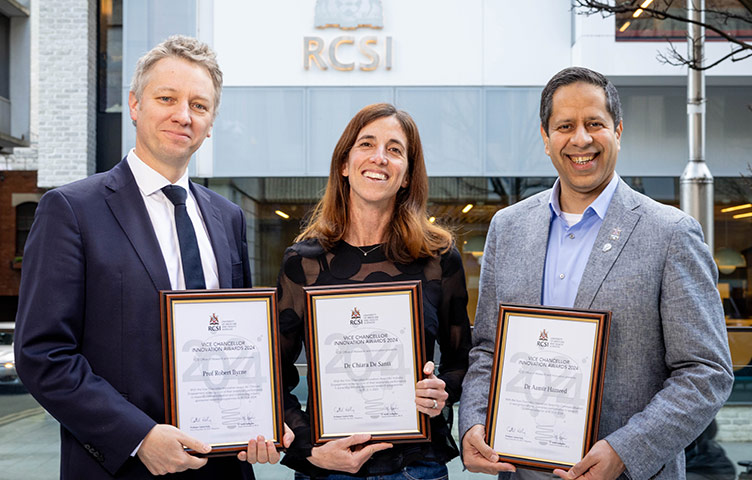
The RCSI Vice Chancellor Innovation Awards winners were presented on the day. The award winners for Commercialisation, Industry Engagement and Clinical Engagement were Dr Aamir Hameed (Department of Anatomy and Regenerative Medicine and the Tissue Engineering Research Group), founder of RCSI spin-out company Pumpinheart; Dr Chiara de Santi (School of Pharmacy and Biomolecular Sciences) for partnership with Vertex Pharmaceuticals; and Professor Robert Byrne (Cardiovascular Research Institute Dublin and School of Pharmacy and Biomolecular Sciences) for his outstanding leadership role in an investigator-initiated study which is funded by industry partner Boston Scientific (CYCLOPES).
Monica Furlong, parent contributor to the CORAL and FLORAL studies
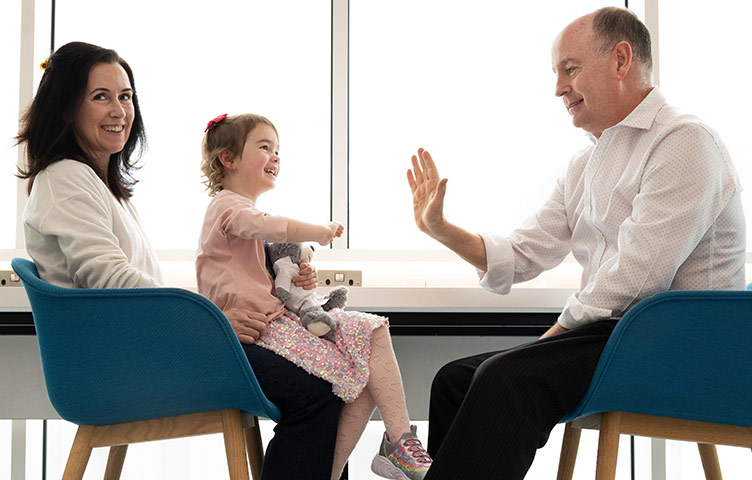
When my daughter Eleanor was born in May 2020, things were very different to what I had experienced after the births of my other children. With limited opportunities to meet other new parents, joining the CORAL study felt like a way to stay connected and be part of something that would be of some benefit during an unusual time.
We had no hesitation in signing up. It was clear from the start that the study was being conducted with care, and that our participation could help inform the long-term understanding of how the pandemic affected early childhood development.
At the in-person appointments tests like allergy and blood samples were done in such a fun and engaging way that Eleanor was completely at ease – it turned into a very positive first experience of hospital, which we really appreciated. As parents, we also valued the early health insights, particularly the allergy testing.
Now, taking part in the FLORAL follow-up study feels like a natural continuation. The RCSI team works in partnership with the families involved and communicates the impact of the research clearly. We’ve always felt that our involvement was genuinely valued.
Being involved in research like this is something I’d encourage other parents to consider. It’s a chance to support work that can benefit children’s health and development – both now and in the future.