WHO Bahrain and RCSI Bahrain sign agreement on workforce training and community engagement

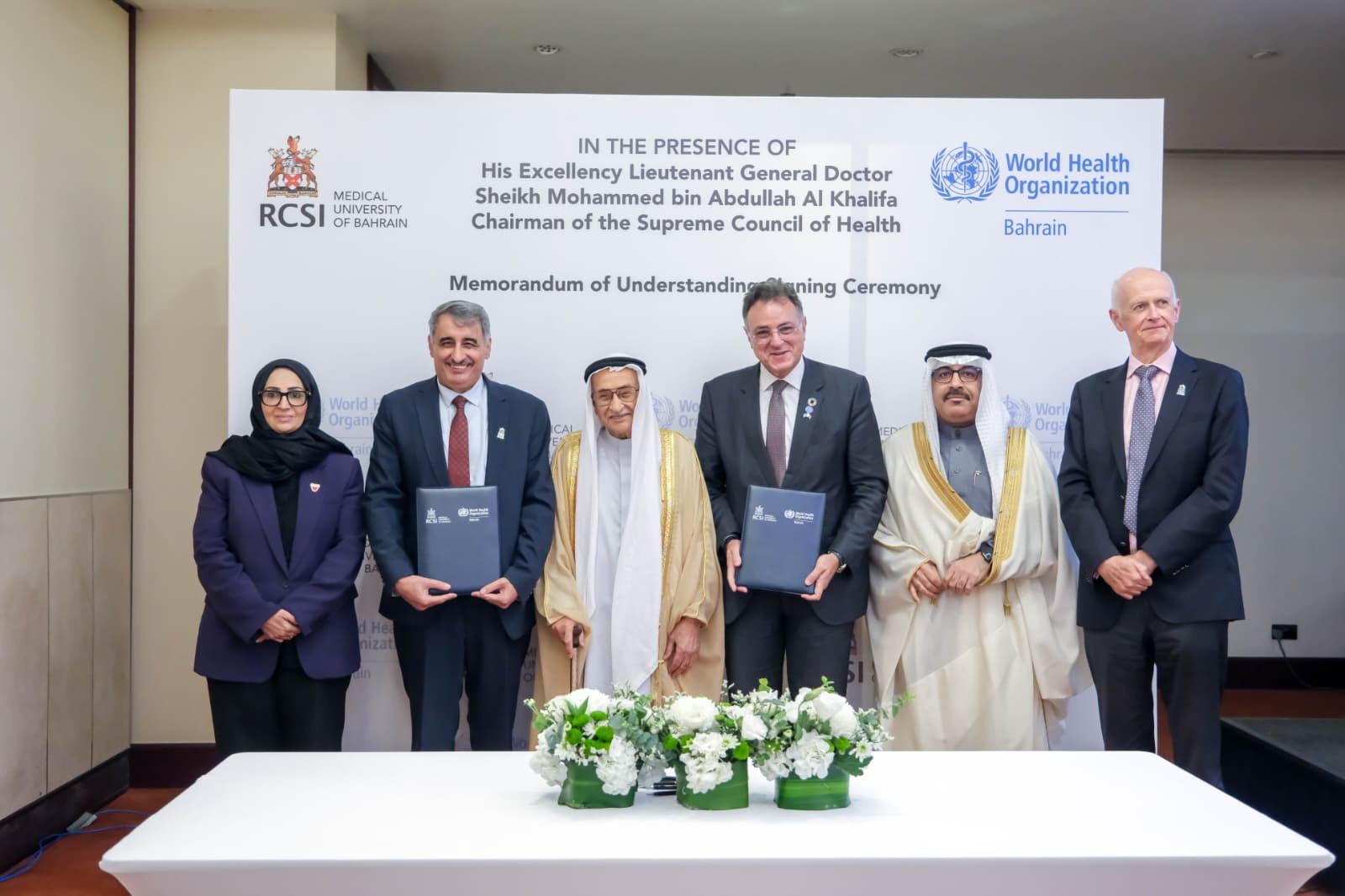
His Excellency Lieutenant General Doctor Shaikh Mohammed bin Abdullah Al Khalifa, Chairman of the Supreme Council of Health, highlighted: “Building on individual expertise and institutional strengths, collaboration between universities, healthcare institutions and international organisations is essential to establishing a shared platform that addresses community needs, advances public health and supports the development of healthcare policies. I look forward to seeing the outcomes of today’s Memorandum of Understanding translated into meaningful initiatives and tangible benefits for the community.” His Excellency’s remarks came during the signing of a Memorandum of Understanding (MoU) between the World Health Organization (WHO) Bahrain Country Office and the Royal College of Surgeons in Ireland (RCSI) – Medical University of Bahrain.
The ceremony was attended by Her Excellency Dr Jalila bint Al Sayyed Jawad Hassan, Minister of Health, and His Excellency Dr Mohammed bin Mubarak Juma, Minister of Education and Chairman of the Board of Trustees of the Higher Education Council, alongside senior officials and healthcare representatives.
The MoU was signed by Dr Adham Ismail, Officer-in-Charge of the WHO Regional Office for the Eastern Mediterranean, and Professor Sameer Otoom, President of RCSI Medical University of Bahrain.
The agreement establishes a framework for strategic cooperation in research, capacity-building, public health outreach, education and innovation. It focuses on advancing global health, with a spotlight on health workforce education, community engagement and health emergencies.
Under the agreement, the WHO Bahrain Country Office will contribute technical expertise and guidance to support joint initiatives between WHO and RCSI Medical University of Bahrain, regularly review progress and identify future priorities.
His Excellency Dr Mohammed bin Mubarak Juma, Minister of Education and Chairman of the Board of Trustees of the Higher Education Council, reaffirmed the Council’s commitment to strengthening collaboration between higher education institutions and specialised organisations in their respective fields, while leveraging academic and research expertise to advance the healthcare sector.
His Excellency noted that this collaboration represents an important step towards achieving these objectives and underscores the vital role of international partnerships in enhancing the quality of education and training, developing qualified national talent capable of keeping pace with advancements in healthcare, and contributing to the achievement of national priorities in education and health.
Her Excellency Dr Jalila bint Al Sayyed Jawad Hassan, Minister of Health, emphasised that the signing of this cooperation agreement between the World Health Organization and RCSI Medical University of Bahrain represents an important step towards strengthening partnerships and collaboration in the fields of health, academia and research. This will contribute to the exchange of expertise and knowledge, the development of national competencies and the promotion of innovation and scientific research in the healthcare sector.
Her Excellency further noted that this agreement highlights the importance of fostering collaboration between academic institutions and international health organisations to support the advancement of medical education and enhance the quality of healthcare services. This is in line with the Kingdom of Bahrain’s vision of building a sustainable healthcare system founded on excellence, innovation and the adoption of international best practices and standards.
She reaffirmed the Ministry of Health’s commitment to supporting such strategic partnerships, which strengthen the Kingdom of Bahrain’s position as a distinguished regional hub for medical education, scientific research and healthcare development, contributing to a more sustainable health future. She also highlighted that investment in healthcare extends beyond service provision to include supporting medical education, advancing scientific research and building national capacities.
“Strong health systems depend on a well-trained health workforce, sound evidence and meaningful engagement with communities,” said Dr Adham Ismail. “This partnership brings together WHO’s technical expertise and RCSI Medical University of Bahrain’s strengths in education and research to advance these priorities.”
“Our collaboration aims to strengthen health systems, build resilience to health emergencies and improve health outcomes for people in Bahrain and across the Eastern Mediterranean Region.”
Professor Sameer Otoom said the University’s ambition is to use the partnership for the benefit of the people of Bahrain: “Our collaboration with the WHO Bahrain Office marks an important step in strengthening our contribution to wider health priorities, generating knowledge and supporting the development of the health care workforce, while creating new opportunities for meaningful collaboration.”
“We look forward to translating this partnership into practical initiatives that contribute to improved health outcomes in the Kingdom of Bahrain and the wider region,” said Professor Otoom.
The agreement builds on RCSI Medical University Bahrain’s experience in International Community Engagement and humanitarian service. Research is also a central component of the partnership. Building on the University’s established public and population health research in areas including diabetes, obesity, cardiometabolic disease, cancer, clinical trials, disease prevention and emerging health care technologies, the MoU creates opportunities for joint studies, data analysis, knowledge development and publications across health systems, global health, community engagement and health emergencies,
The MoU provides a foundation for sustained cooperation between WHO Bahrain and RCSI Medical University of Bahrain, with a shared focus on delivering meaningful and lasting contributions to health care in Bahrain and the wider region.
This collaboration aligns with the United Nations Sustainable Development Goal 17 (Partnerships for the Goals), reinforcing the importance of strategic partnerships in advancing healthcare education, research and community wellbeing.