
Two colleagues examine something on a laptop screen)

MSc in Nursing


School of Postgraduate Studies and Research

Programme details

The programme is approved as a full-time course with the option of part-time attendance over two academic years. This option is considered essential in order to facilitate nurses who wish to continue in nursing practice during their studies. The programme is modularised and has been developed in the context of a modular framework modelled on the European Credit Transfer System (ECTS) Level 9 as recommended by the EU Bologna Accord. It is a major award positioned at Level 9 on the National Qualifications Framework (NQF) and the National Framework of Qualifications (NFQ).

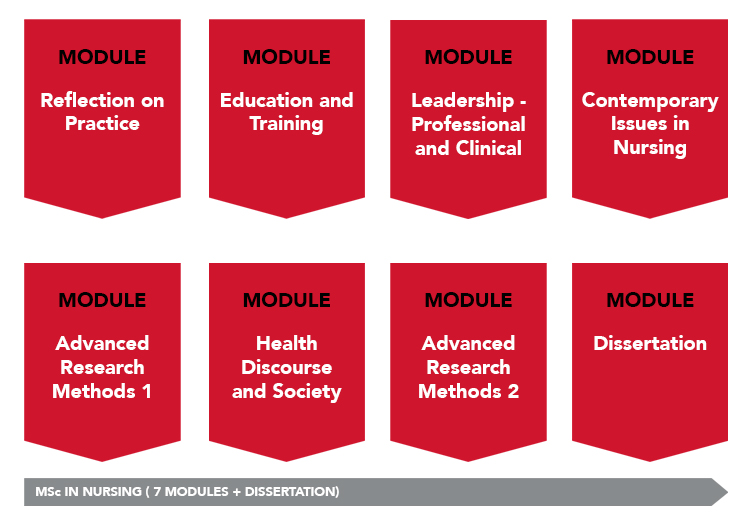
The programme is modular in structure with a total of eight modules. Each module is delivered over a period of one week i.e. Sunday to Thursday from 08.30 to 16.00hrs, the second year of the programme includes a research dissertation.
Modules

Year 1 - Semester One

  • Module 1 (MSCN1) - Reflection on Practice: The aim of this module is to develop critical thinking skills through reflective practice. Facilitated Reflective Practice sessions are provided to support the students in their learning. They are required to build a portfolio to demonstrate their learning by linking theory to practice.
  • Module 2 (MSCN2)- Education and Training in Practice: this module provides the student with an understanding of the principles of education, teaching and learning as an integral part of any nurses' role, whether teaching patients, families, colleagues or students. This module is assessed by applying acquired knowledge to design an educational training programme for a targeted group of learners.
  • Module 3 (MSCN3)- Contemporary Issues in Nursing: The content of this module is dynamic to reflect on the complex and ever-changing world of health care and how it impacts on nursing and nursing care. The module whilst online requires the student to demonstrate their appreciation of the current issues in nursing and their leadership potential in respect to initiating online discussion, moderation and assessment of the group discourse.

Year 1 Semester Two

  • Module 4 (NSCN4)- Advanced Research Methods I: This is the first of two research modules and introduces students to research process and the differences between quantitative and qualitative research approaches. In this module, students are required to identify a research topic relevant to their area of practice and develop a research proposal.
  • Module 5 (MSCN5)- Leadership: Professional & Clinical: The module aims to explore leadership in nursing from different perspectives encouraging the student to examine the importance of leadership in influencing and shaping nursing practice. The module provides the student with an appreciation and understanding of the processes of leadership as distinct from management and how nurses need to develop and strengthen their leadership through the development of expert practice.
  • Module 6 (MSCN6)- Health Discourse and Society: This module is designed to develop the students understanding on health and its impact on society, and the theories underpinning society, cultural and how it works. The relevance of this module to the nurse in clinical practice is that it helps give a more in-depth understanding of the patient and their family in context and how that may affect how they react to care and treatment. This module is particularly important in today's globalisation, technology, artificial intelligence, healthcare liability, and health and medical tourism.

Year 2 Semesters One and Two

  • Module 7 (MSCN7)- Advanced Research Methods 2: This is the second advanced research module, offered in the second year of the programme, which aims to further develop students’ research skills as they undertake key tasks related to their primary research project, including obtaining ethical approval, recruiting participants, collecting and analysing data.
  • Module 8 (MSCN8) - Dissertation: Students are required to submit a full written dissertation in accordance with academic conventions. The dissertation is supervised by an academic holding a doctoral qualification. Students are also expected to undertake a viva and deliver an oral presentation to defend their thesis. In writing this dissertation it will develop the student’s writing ability and how to structure their work in a coherent and logical way. This skill is transferrable to report writing as is always required by nurses as they endeavour to influence decision-making at different levels throughout the organisation.