Vice Chancellor’s review
By Professor Cathal Kelly, Vice Chancellor and Chief Executive/Registrar
This annual report gives me a welcome opportunity to share the achievements of the RCSI community during 2024/2025, during which we continued to work together in service of our mission to educate, nurture and discover for the benefit of human health.
Now in the second year of delivery of our 2023–2027 strategy, Innovating for a Healthier Future, our community of academics, researchers, clinicians and professional staff have made considerable progress in advancing our objectives, delivering meaningful impact for patients, learners and society. These achievements are underpinned by collaboration across disciplines and partnerships nationally and internationally. I was delighted that this commitment was recognised when RCSI was ranked number one in the world for SDG 3 ‘Good Health and Well-being’ in the Times Higher Education (THE) University Impact Rankings 2025, the third time we have achieved this global distinction. This recognition affirms our leadership in advancing health and well-being for all and our commitment to the UN Sustainable Development Goals.
School of Dentistry
Our new School of Dentistry made significant progress in preparing for its inaugural Bachelor of Dental Surgery (BDS) intake in September 2025. Our new Dental Education Centre at Sandyford, which includes 12 clinical chairs and 55 simulation units, was completed in June, with the official opening planned for July. Construction continues on a second Centre at Connolly Hospital, and a third Centre is in advanced planning. These facilities will support a modern, patient-centred education model and expand access to care, improving oral health in underserved areas.
Student demand for the BDS programme has been strong and the School will take the full government allocation of 20 CAO places, increasing national capacity by one-third and helping address the shortage of dentists in Ireland. Once fully up and running, we will train 375 students across the five-year programme and deliver 30,000 community dental treatments each year.
Supporting health and well-being
We advanced our commitment to supporting health and societal well-being at local, national and global levels throughout the year, with our achievements underscoring RCSI’s leadership in shaping a healthier and more sustainable society.
Our access and widening participation programmes expanded, with new scholarships and continued contributions to the national access schemes HEAR and DARE. Through initiatives like REACH RCSI, the Creative Arts Summer School and school-based STEMM outreach, we strengthened pathways into higher education for underrepresented groups and inspired the next generation of healthcare professionals. Public, patient and community engagement also deepened. Physiotherapy students delivered weekly exercise classes for older adults, and through partnerships with advocacy groups, we promoted patient involvement in research across conditions including epilepsy, cancer and Sjögren’s disease.
Looking ahead, RCSI’s new health gallery at 118 St Stephen’s Green will create an innovative public space for dialogue on health and well-being, further embedding RCSI’s role as a trusted source of accessible health information.
RCSI responded to global health challenges with practical impact, supporting humanitarian work in Gaza through field hospital collaboration and the open-access SURGHub platform which was recognised with a Times Higher Education Award for digital innovation.
Our sustainability agenda delivered major progress, including a 51.4% improvement in energy performance and My Green Lab Accreditation achieved in all research and teaching laboratories.
Education
Under the leadership of Professor Tracy Robson, who assumed the role of Deputy Vice Chancellor for Academic Affairs in June 2024, RCSI’s schools and academic departments advanced their mission to deliver innovative programmes across Undergraduate and Postgraduate levels, preparing students and scholars to become future leaders in healthcare and health sciences.
The Schools of Pharmacy and Biomolecular Sciences and Physiotherapy significantly expanded student intakes in response to the government’s call to increase the number of health sciences graduates. Now in its third year, the BSc in Advanced Therapeutic Technologies continues to work closely with industry partners to address critical skills gaps.
Our transformative medicine curriculum also continued to mature, with the introduction of a new clinical tutor system providing hands-on support for students in real clinical settings. At the same time, new offerings such as the MSc in Population Health Management and pioneering micro-credentials in nursing highlighted our responsiveness to the evolving needs of the health system.
Supporting student success remains a cornerstone of our approach. Expanded programmes in mental health, resilience and career development were complemented by strong engagement through initiatives such as the StEP programme and the RCSI CareerHub, a dynamic platform offering workshops, internships, networking opportunities and tailored career guidance for our students.
Research and innovation
Our researchers and clinician scientists, with the support of RCSI’s Office of Research and Innovation, delivered exceptional outcomes during the year, with a continued focus on translational and patient-centred research. An outstanding €44.8 million in new external grants was secured, our researchers published more than 1,650 PubMed-indexed articles, and RCSI became the first university in Ireland to achieve My Green Lab Certification across all labs. These achievements underscore RCSI’s position as a leader in sustainable, translational and patient-focused research.
Clinical research flourished through the Beaumont RCSI Cancer Centre and the Clinical Research Centre, which expanded capacity, improved processes and tripled participant recruitment.
The Beaumont RCSI Cancer Centre launched the Beaumont RCSI Irish Cancer Society Lung Health Check, a landmark pilot national lung cancer screening study as part of a €4.9 million programme, led by Professor Jarushka Naidoo, and the €5 million PRISM programme, led by Professor Leonie Young, which aims to improve survival and quality of life for patients with metastatic breast cancer through precision oncology approaches. These groundbreaking initiatives represent one of Ireland’s most ambitious cancer research efforts and reflect RCSI’s impact in advancing personalised medicine.
Research led by Professor James O’Donnell identified a new subgroup of patients with von Willebrand disease, the most common inherited bleeding disorder. These patients had normal amounts of the clotting protein but still experienced bleeding problems because the protein didn’t function properly. This finding means doctors can now better diagnose the condition and ensure patients receive the right treatment.
The RCSI Tissue Engineering Research Group, led by Professor Fergal O’Brien, developed a new 3D-printed implant that carries tiny electrical signals to encourage nerve repair after spinal cord injury and Professor Jonathan Hourihane launched the FLORAL study, examining how the gut microbiome affects children’s health by comparing children born during the COVID-19 pandemic with those born afterwards. Innovation and industry engagement accelerated, with RCSI ranked third nationally for spin-out formation and first for collaborative agreements signed. Our researchers launched new spin-outs, won national start-up awards and deepened partnerships with SMEs and multinationals.
A growing campus
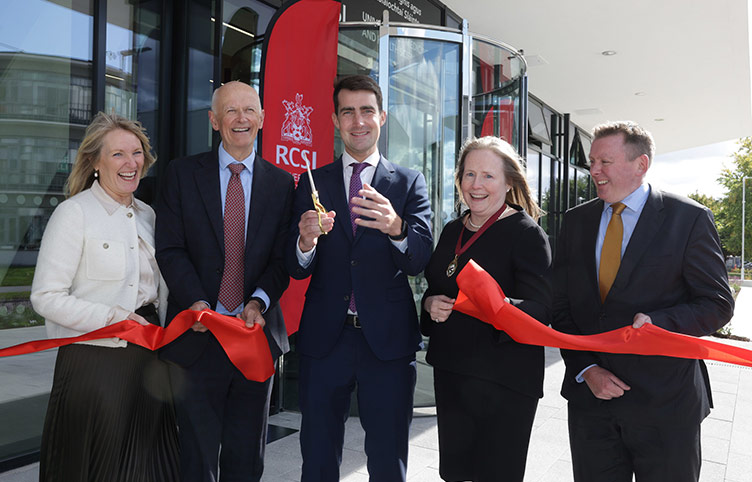
At the time of this report, RCSI’s €99 million development at 118 St Stephen’s Green was close to completion, marking a major milestone in the university’s campus evolution by creating a new 'front door' and a vibrant hub for education, research and student life and reinforcing RCSI’s historic connection to St Stephen’s Green.
Our campus further expanded during the year with the Connolly Education and Research Centre opening.
Positive culture
RCSI continues to foster a positive workplace culture, rooted in our values of respect, collaboration, scholarship and innovation and our commitment to equality, diversity and inclusion. In 2025, we were proud to be recognised as Inclusive Champion for Gender Equality by the European Commission. Our School of Pharmacy and Biomolecular Sciences secured RCSI’s first Athena Swan Silver Award, with further success in Bronze renewal. We again took part in the Sunday Times Best Places to Work survey, ranking 'excellent' in 2024 and 2025, with engagement scores over 10% above global benchmarks.
Official Languages Act
RCSI remains committed to meeting its obligations under the Official Languages Act 2003. Bilingual signage around campus is increasing in use and will continue to be rolled out incrementally, thanks to the work of our Estates team.
RCSI has made substantial progress in fulfilling its advertising obligations through Irish and I would like to acknowledge the Communications and Marketing Departments for their efforts in this regard.
Thank you
RCSI is defined by the talents of its people. I am immensely proud to work with the academics, researchers, clinicians and professional staff who, every day, demonstrate their dedication to advancing knowledge and innovating for a healthier future.
I would particularly like to acknowledge the commitment and effort of our students, who are the healthcare leaders of tomorrow and at the heart of everything we do.
I am especially grateful for the support of President Professor Deborah McNamara and the RCSI Council throughout the year.
Finally, thank you to my colleagues on RCSI’s senior management team. Their vision and dedication remain a driving force behind our strategic progress. I thank them sincerely for their continued leadership and collegiality.