RCSI 26 York Street and Symphony Energy named World Champions for Energy Savings at COP31

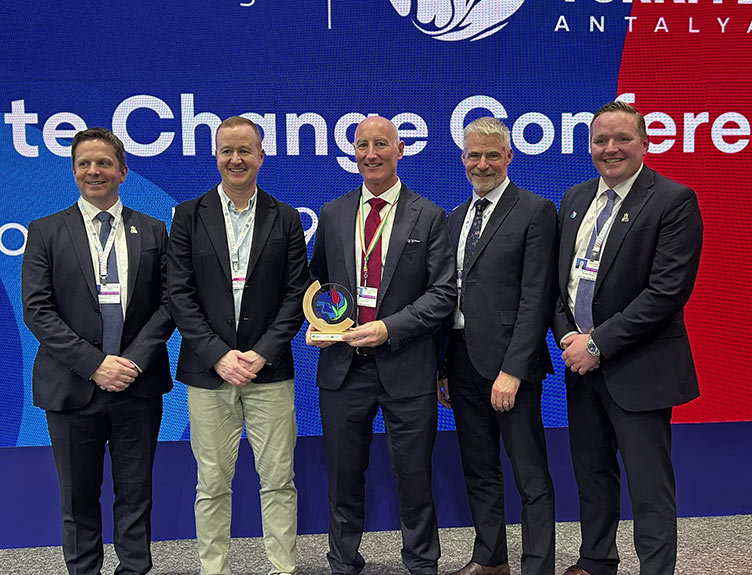
RCSI University of Medicine and Health Sciences and Symphony Energy have received international recognition at the United Nations Climate Change Conference (COP31) in Antalya, Türkiye, for the outstanding energy performance of RCSI's 26 York Street building in Dublin.
The building was named a winner in the World Championship for Energy Savings (WCES), in the Existing Buildings: Operational Excellence category, recognising a 40.5% reduction in whole-building energy consumption through innovative technology that optimises existing heating, ventilation and air-conditioning (HVAC) systems.
The World Championship for Energy Savings is an initiative of the Global Alliance for Buildings and Construction (GlobalABC), recognising buildings that demonstrate significant improvements in energy performance. The award highlights the potential for innovative technology to reduce energy consumption and carbon emissions in existing buildings.
RCSI's 26 York Street was selected from five international finalists, including Hay's Galleria, London; La Galerie Shopping Centre, Villefranche-sur-Saône, France; the Museum of Modern Art (MoMA), New York; and TARSHID Headquarters, Riyadh.
The award recognises the building's contribution to advancing the decarbonisation of the buildings and construction sector, in line with the principles of the UN Buildings and Climate Global Forum Chaillot Declaration.
The energy savings were achieved through the deployment of Symphony Energy's optimisation technology. Rather than replacing existing equipment, the technology uses advanced algorithms and building management system data to optimise the operation of the building's heating, ventilation and air-conditioning systems in response to changing requirements.
A key element of the technology is Symphony Cycle, a patented heat-recycling process that enables waste heat to be reused for heating while supporting the building's cooling requirements.
Professor Cathal Kelly, Vice Chancellor of RCSI, said: “This international recognition is a significant achievement for RCSI and reflects our commitment to embedding sustainability across all aspects of the University's operations.
“I am exceptionally proud that our efforts in reducing the environmental impact of 26 York Street have been recognised on a global stage. Through innovation and collaboration with Symphony Energy, we have delivered substantial improvements in energy efficiency, while maintaining the high-quality facilities that support our students, staff and wider University community.”
Tom Ascough, Co-founder and Managing Director of Symphony Energy, said: “Achieving World Champion recognition for our industry-disrupting technology is an immense achievement for Symphony Energy, highlighting its potential to improve energy performance in public and commercial buildings worldwide, driving real progress towards national emissions reduction targets.
“The project at RCSI's 26 York Street building demonstrates how best-in-class control and optimisation of existing building systems can complement good original design, helping building owners enhance operational performance in a commercially viable way.”
Ronan Baxter, Director of Estates, RCSI, said: “RCSI and Symphony Energy have worked in partnership on this project since its inception in 2020. As an early adopter of Symphony's cutting-edge technology, RCSI has achieved significant, real-world energy savings which have been instrumental in RCSI's commitment to the Climate Action Plan and a 50% global reduction in carbon emissions by 2030. In addition, the Symphony Cloud platform was a key enabler for RCSI achieving ISO 50001 certification for energy management across our institution in 2025. The RCSI Estates team continues to work collaboratively with Symphony Energy and is delighted to have received this international recognition at COP31.”
Cédric Borel, CEO, Action For Market Transformation (A4MT), said: “To deliver the Antalya Compact, we must measure results. The WCES shows that substantial savings are achievable today, and that they can be measured, compared, verified and regulated. That is the evidence governments need to build stronger regulation, grounded in the most effective sufficiency and efficiency practices in the market.”
Peter Templeton, President & CEO, US Green Building Council, said: “The World Championship for Energy Savings is an important opportunity to spotlight the building owners and operators delivering measurable reductions in energy consumption and carbon emissions, and setting an example for the broader industry. This year's honorees include several LEED-certified projects, demonstrating how green building leadership can deliver real-world results and inspire progress across the built environment.”
Located in RCSI's Dublin city centre campus, 26 York Street provides learning, study and recreational facilities across 10 floors and is home to one of Europe's most advanced clinical healthcare simulation centres. The building was voted Ireland's Favourite Building at the RIAI Irish Architecture Awards in 2018.
The World Champion achievement reflects RCSI's wider commitment to sustainability across its education, research and campus operations. Since 2020, RCSI was ranked number one in the world three times for Good Health and Well-being in the Times Higher Education Sustainability Impact Ratings and continues to maintain a top ten position. In 2025, RCSI was appointed as one of Ireland's Sustainable Development Goal (SDG) Champions for 2025–2027 and was the first university in Ireland to achieve My Green Lab certification across all its laboratories and teaching labs.
The World Champion recognition also acknowledges the wider collaboration behind the building's energy performance, including architects Henry J Lyons; the Chartered Institution of Building Services Engineers (CIBSE), which nominated the building; and SEAI, which supports energy efficiency and innovation in Ireland.